Bluey Vuitton vs Blue Meanie: What's the Difference?
Bluey Vuitton is a pale Psilocybe cubensis variety with big, wavy caps and heavy blue bruising. "Blue Meanie" can mean two different things: a cubensis strain sold under that name, or Panaeolus cyanescens, a separate wild species. So the honest answer is: it depends which Blue Meanie you mean.
By the Cap & Stem team · Published · 7 min read
We get this question a lot at the counter, usually from someone who's heard about "the blue ones" and wants to know if Bluey Vuitton is the same thing as a Blue Meanie. They're not, and the reason is a little more interesting than you'd expect, because "Blue Meanie" isn't even one mushroom. Let's sort it out.
What is Bluey Vuitton?
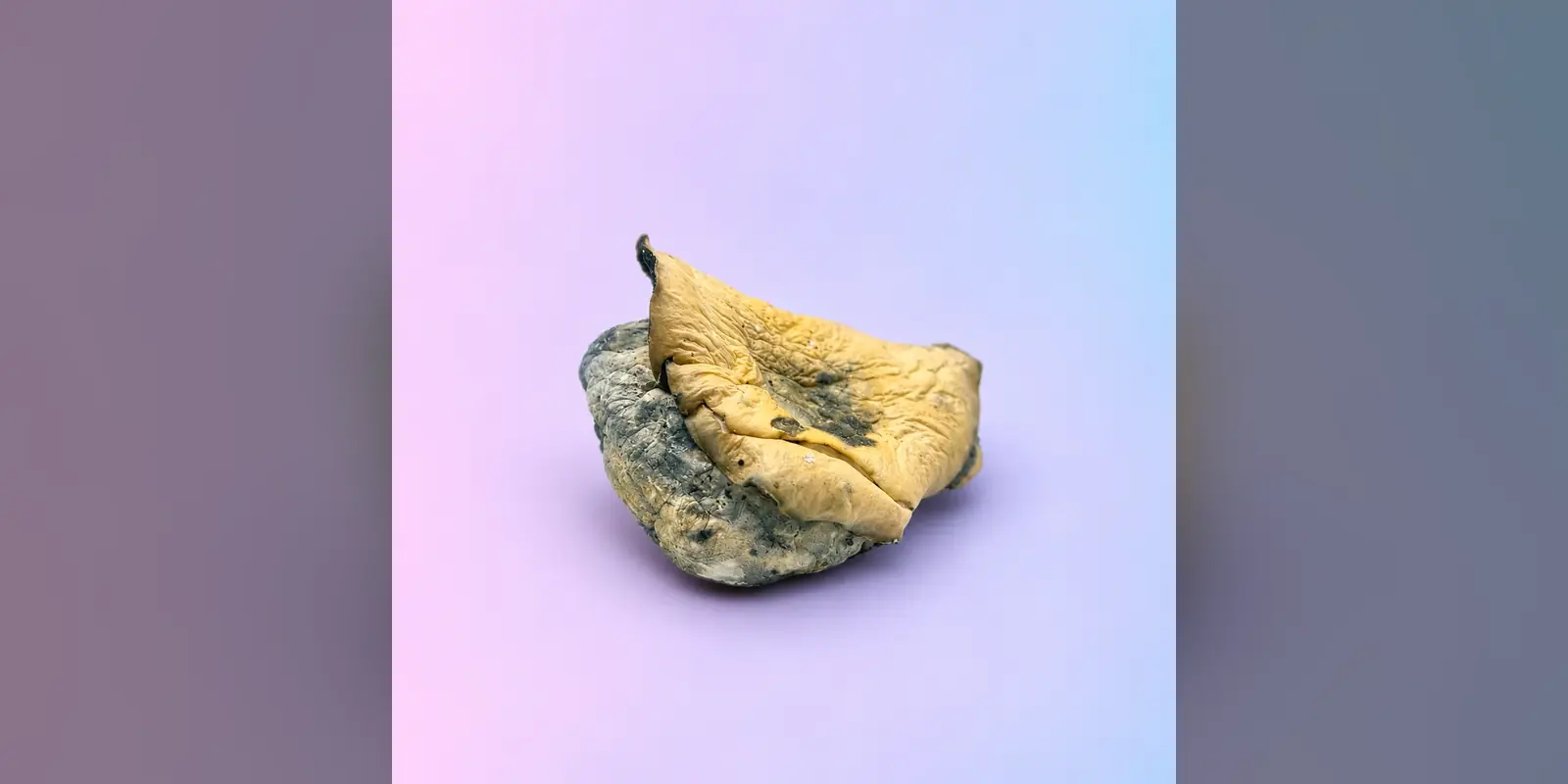
Bluey Vuitton is sold as a Psilocybe cubensis variety, the same species as Golden Teacher, Penis Envy and most named strains you'll see in shops. It's one of the easiest strains on our shelf to recognize: broad, flat, wavy caps in a pale cream color, often streaked with deep blue bruising across the surface.
The name is a playful pun on a fashion brand, combined with that blue color. Its lineage isn't well documented. You may see it described online as a cross of other pale strains, but we can't verify that, so we don't claim it.
On our menu, Bluey Vuitton is a Level 3. Customers most often describe it as euphoric, visual and relaxed, with a warm, cozy body feel, and it's the strain people mention for a chill night in with good music. Those are common descriptions, not promises; everyone responds differently.
What is a Blue Meanie?
Here's where it gets confusing. "Blue Meanie" is used for two different mushrooms, and people often don't realize which one they're talking about.
1. Blue Meanie the cubensis strain
There's a Psilocybe cubensis strain sold as "Blue Meanie." It's the same species as Bluey Vuitton, and it's named for the way it bruises blue. A lab co-founder interviewed by GreenState said they've tested Blue Meanies that turned out to be cubensis, and noted that a cubensis strain by that name is commonly grown indoors (GreenState). Like a lot of strain names, its exact origin isn't well documented.
2. Blue Meanies the wild species (Panaeolus cyanescens)
The original "Blue Meanies" are Panaeolus cyanescens, sometimes called Copelandia cyanescens. It's a different genus from cubensis. These are small mushrooms, roughly 1.5 to 4 cm across, with thin stems, caps that start light brown and fade toward gray-white, and gills that turn black as they age. They grow on dung in warm, subtropical places around the world, and bruise a blue that can look almost green (GreenState; Shroomer).
There's a popular story that the name comes from the Blue Meanies in the Beatles film Yellow Submarine. It's a fun theory, but there's no official confirmation (Shroomer).
| Bluey Vuitton | Blue Meanie (cubensis strain) | Blue Meanies (Panaeolus cyanescens) | |
|---|---|---|---|
| Species | Psilocybe cubensis | Psilocybe cubensis | Panaeolus cyanescens |
| Look | Large, flat, wavy cream caps | Classic cubensis shape | Small, thin, bell-shaped caps |
| Bruising | Heavy blue | Heavy blue | Blue to blue-green |
| Where it comes from | Indoor cultivated variety | Indoor cultivated strain | Grows wild on dung in warm climates |
| Known origin | Not well documented | Not well documented | Natural species |
| At Cap & Stem | Yes, Level 3 | Not currently carried | Not carried |
So what's actually different?
Species
Bluey Vuitton and the cubensis Blue Meanie are cousins: same species, different named varieties. Panaeolus cyanescens is a different genus altogether. That's the biggest difference, and it's why "is Bluey Vuitton a Blue Meanie?" doesn't have a simple yes or no.
Look
If you put them side by side, Bluey Vuitton is the one with the big, open, wavy caps. A cubensis Blue Meanie looks like a fairly classic cubensis. Panaeolus cyanescens is much smaller and thinner, more like a delicate field mushroom.
Blue bruising
All three bruise blue, which is where the confusion starts. Blue bruising is a common reaction in psilocybin mushrooms when they're handled or damaged. It's a visual trait, and on its own it doesn't tell you how strong a mushroom is. That's why we rate every strain on our own Level scale instead of going by color.
Reputation
Panaeolus Blue Meanies have a reputation for being stronger than cubensis, and you'll see the claim that they have "double" the psilocybin. That's a common belief more than a settled fact. The lab co-founder GreenState interviewed said the Panaeolus samples he'd screened were generally more potent than cubensis, but added, "I wouldn't say the blue meanie is the most potent mushroom" (GreenState). Potency varies a lot from batch to batch for any mushroom.
There's also a belief that Blue Meanies are more visual. The same article notes there's no scientific evidence for that, and that the effects aren't very different from other psilocybin mushrooms; the differences are mainly potency and appearance.
What does "strain" actually mean?
With mushrooms, "strain" usually means a named variety within one species, most often Psilocybe cubensis. Growers select mushrooms with traits they like, such as cap shape, color, how fast they grow or how heavily they bruise, and keep growing from those. Over time a variety gets a name, and the name sticks.
That's why strain names can be a bit like band names: memorable, but not always descriptive or consistent. Two shops selling something called the same name may not be selling identical mushrooms, and a single strain can vary from batch to batch. It's also why we put our own Level on every strain we carry, based on our batches, rather than relying on the name alone.
Why so many "blue" names?
Blue shows up in a lot of strain names, from Bluey Vuitton to Blue Ghost to Blue Meanie. The reason is simple: blue bruising is one of the most recognizable things about psilocybin mushrooms, and pale strains show it off the most. On a cream-colored cap, a blue streak is hard to miss, so growers lean into it when naming.
It's worth repeating, because it's one of the most common misconceptions we hear: more blue doesn't automatically mean stronger. Bruising depends on how the mushrooms were handled, dried and stored, as well as the variety. Treat it as a fun visual clue, not a strength rating.
A word on foraging
Because Panaeolus cyanescens grows wild, people sometimes ask about finding it. We don't recommend foraging for psilocybin mushrooms. Many small brown and gray mushrooms look alike, and some wild mushrooms are seriously dangerous to misidentify. Shroomer makes the same point, noting that Blue Meanies can be confused with toxic species (Shroomer).
If you like the idea of a Blue Meanie, try these
We don't carry a Blue Meanie right now, but if what draws you in is the striking blue look, a few strains on our menu fit the bill:
- Bluey Vuitton (Level 3): big wavy caps, heavy bluing, described as warm and euphoric.
- Blue Ghost (Level 3): pale, heavily blue-bruising, described as calm and floaty.
- Casper (Level 3): pale with blue-tinged stems, described as dreamy and upbeat.
- Albino Penis Envy (Level 3): pale and chunky, with blue-gray bruising, described as vivid and immersive.
All four are Level 3, so they're not first-time picks. If you're new, start with a Level 1 like Golden Teacher and work up on separate days. Our strain guide has every strain we carry, side by side.
Before you try any Level 3 strain
- Know how you respond to lower Levels first.
- Pick a calm, familiar place and clear your whole day.
- Have a sober friend you trust nearby.
- Don't mix with alcohol or other substances, and talk to a healthcare provider first if you take medication.
- Don't drive for the rest of the day.
Find Bluey Vuitton in Ann Arbor
Bluey Vuitton is on the menu at Cap & Stem, 814 S State St, just south of U of M's campus. You need to be 21+ with a valid photo ID, and we're cash only. Walk in, or order ahead online and pick up in store. Coming from out of town? We have drive guides for Ypsilanti, Detroit and more on our visit page.
Common questions
Is Bluey Vuitton a Blue Meanie?
No. Bluey Vuitton is its own Psilocybe cubensis variety. "Blue Meanie" can mean a different cubensis strain or Panaeolus cyanescens, a separate species.
Are Blue Meanies stronger than Bluey Vuitton?
Panaeolus Blue Meanies have a reputation for being strong, but potency varies by batch and the "double strength" claim isn't settled. We rate the strains we carry on our own Level scale; Bluey Vuitton is Level 3.
Why do these mushrooms turn blue?
Blue bruising is a common reaction in psilocybin mushrooms when they're handled or damaged. It doesn't tell you how strong a mushroom is on its own.
Does Cap & Stem sell Blue Meanies?
Not right now. We carry Bluey Vuitton and other pale, blue-bruising strains like Blue Ghost and Casper.
Is Bluey Vuitton good for beginners?
It's a Level 3, so we suggest starting with a Level 1 strain like Golden Teacher first.
Is Blue Meanie a cubensis?
It can be. A cubensis strain is sold as Blue Meanie, but the original Blue Meanies are Panaeolus cyanescens, a different genus.
What's the difference between Bluey Vuitton and Blue Ghost?
Both are pale, blue-bruising Level 3 strains. Bluey Vuitton has big, flat, wavy caps and is described as warm and euphoric; Blue Ghost has small, rounded caps and is described as calmer and floatier.